
Getting Around Bangkok: The Simple Guide for First Time Visitors

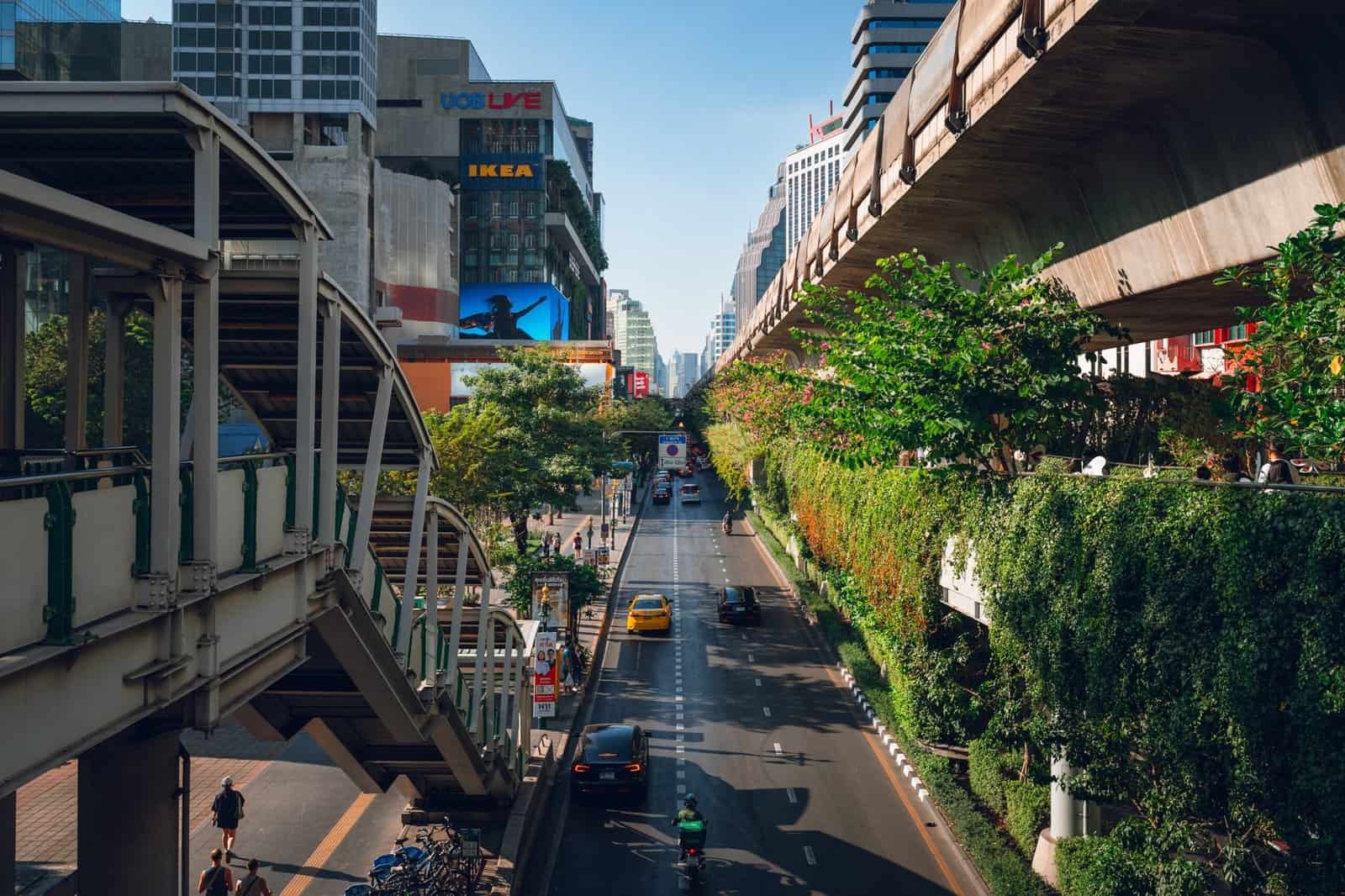
Getting around Bangkok is easier than most first time visitors think, even though the city is huge. Bangkok uses a mix of skytrains, subways, boats, taxis, tuk-tuks, and two airports, and once you understand a few basics, moving around is straightforward.
The main rail systems are the BTS Skytrain, MRT Subway, and Airport Rail Link. Many routes use a mix of lines, and knowing when to use each one makes a big difference.
I’ve lived in and out of Bangkok for the last three years and use these routes every time I’m in the city. Everything here comes from real experience and reflects what actually works for first-time visitors.
This post contains affiliate links. If you use them, I may earn a small commission at no extra cost to you. I only recommend places and services I personally trust. Thanks for your support.
Quick overview
BTS Skytrain: The fastest way to avoid traffic in central areas. Best for Sukhumvit, Siam, and Silom.
MRT Subway: Ideal for Chinatown, Ratchada, Chatuchak Market, and areas the BTS does not reach.
Airport Rail Link: The simplest way to get from Suvarnabhumi Airport into the city when you travel light.
Chao Phraya River Boats: Great for reaching the Grand Palace, Wat Pho, Wat Arun, and other Old Town spots without sitting in traffic. The tourist Blue Flag boat is also available through the Chao Phraya Tourist Boat Pass.
Grab (Thailand’s version of Uber): Useful for late nights, luggage, hotel transfers, and places far from train lines. Grab works best with mobile data, so set up an eSIM before you arrive.
Tuk-tuks: Fun for short trips and a classic Bangkok experience, but not the cheapest option.
Buses: Cheap and available everywhere, though less practical for a short first trip.
Motorbike taxis: Fast and inexpensive, but not ideal for most visitors since helmets are not always provided and traffic can feel intense.
Choosing where to stay?
If getting around feels confusing, where you stay usually matters more than which transport you choose. Our Where to Stay in Bangkok guide breaks down how areas are laid out so you can pick a base that keeps daily travel simple.
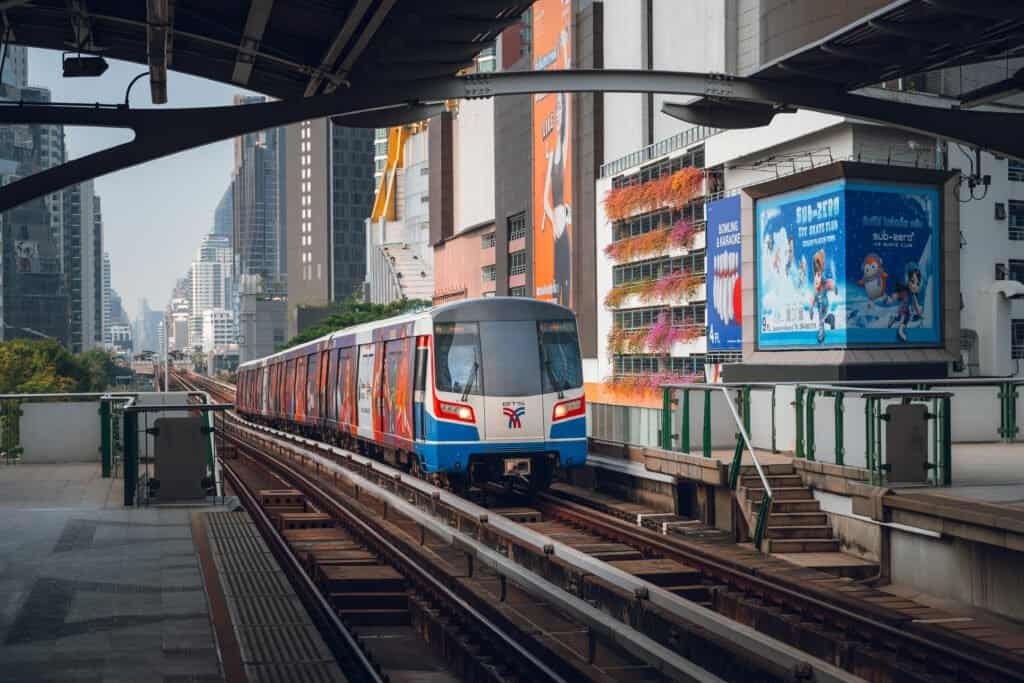
BTS skytrain in Bangkok
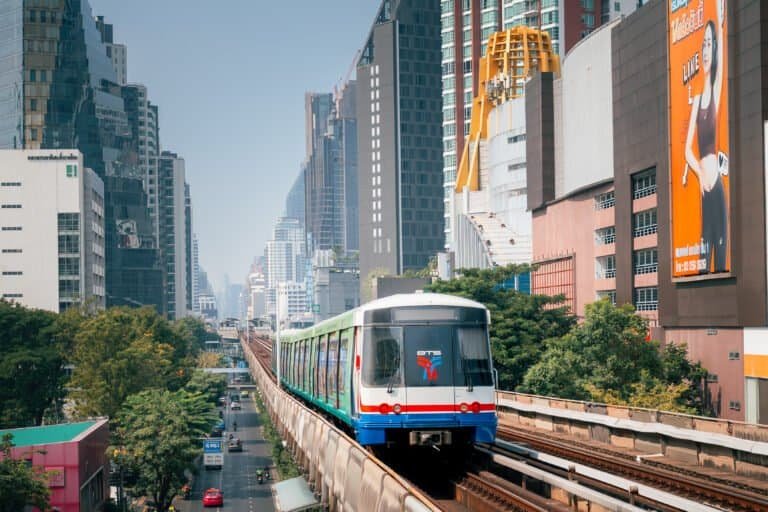
The BTS Skytrain is one of the quickest ways to travel across central Bangkok. It runs above traffic, connects major neighborhoods, and is straightforward for visitors to learn.
Where the BTS goes
The two main lines cover the areas most travelers spend time in.
- Sukhumvit
- Siam
- Asok
- Nana
- Phrom Phong
- Thonglor
- Ekkamai
- Silom
- Mo Chit
These lines connect at Siam Station, the main interchange.
How much it costs
Fares usually fall between 16 and 59 THB, depending on distance.
Bangkok adjusts prices from time to time, but these ranges stay consistent.
If you expect to make several rides in a day, you can buy a BTS day pass, though it only pays off if you plan to use it multiple times.
When to use it
Use the BTS when you want reliable travel across central Bangkok. It is ideal for:
- Shopping areas and malls
- Hotel transfers within Sukhumvit
- Reaching river boats at Saphan Taksin
- Avoiding traffic during busy hours
If you want step-by-step help buying tickets or tapping in, I break that down in the full BTS/MRT guide.
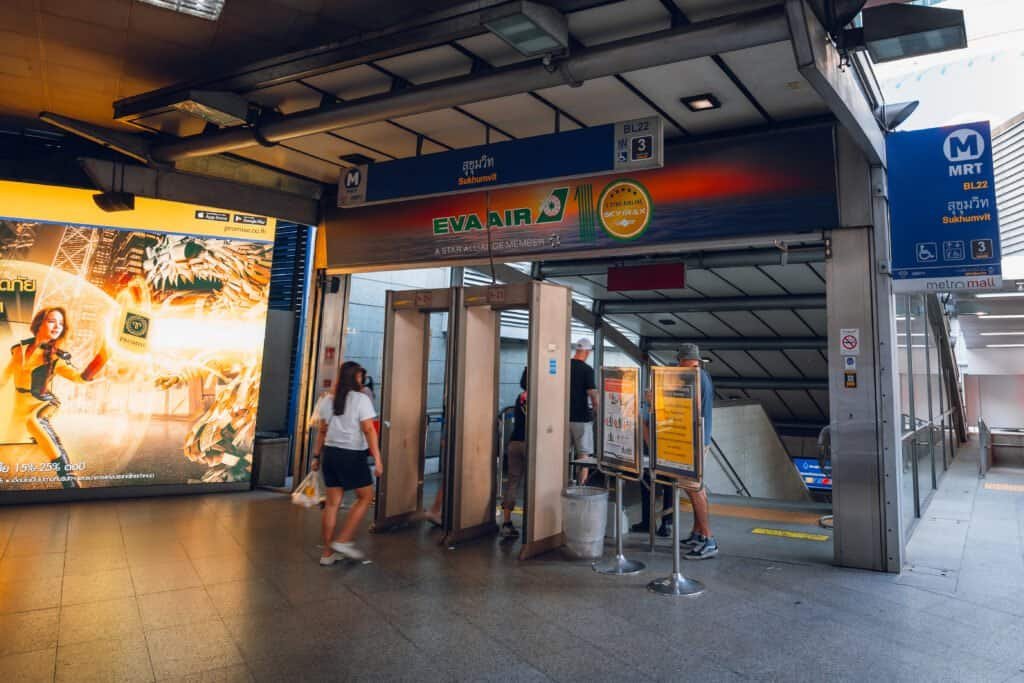
MRT subway in Bangkok
The MRT Subway fills in the areas that the BTS does not reach. It runs underground, connects major neighborhoods, and is one of the most reliable ways to reach Chinatown, Ratchada, and Chatuchak Market.
Where the MRT goes
The Blue Line is the route most visitors use. It connects directly to:
- Chinatown
- Ratchada
- Thailand Cultural Centre
- Chatuchak Park
- Sukhumvit
- Old Town
The Purple Line and Yellow Line reach more local neighborhoods and help for longer stays, but are less important for short trips.
How much it costs
Tickets usually cost 17 to 45 THB, depending on distances.
Prices stay consistent year to year, so this range is reliable for planning.
When to use it
Use the MRT when you want fast access to areas the BTS does not reach, including:
- Chinatown food streets
- Chatuchak Market
- Ratchada night markets
- The Grand Palace area via Sanam Chai
- Cultural sites along the Blue Line loop
The MRT is also helpful for moving between BTS lines during busy hours.
Many MRT stations connect to small underground mall areas with cafes and shops, which can be useful if you need food or a quick break between stops. The air conditioning underground can also feel colder than expected, so a light layer helps.
You cannot eat or drink in paid areas of the BTS or MRT, and staff will stop you if you try to bring food through the gates.
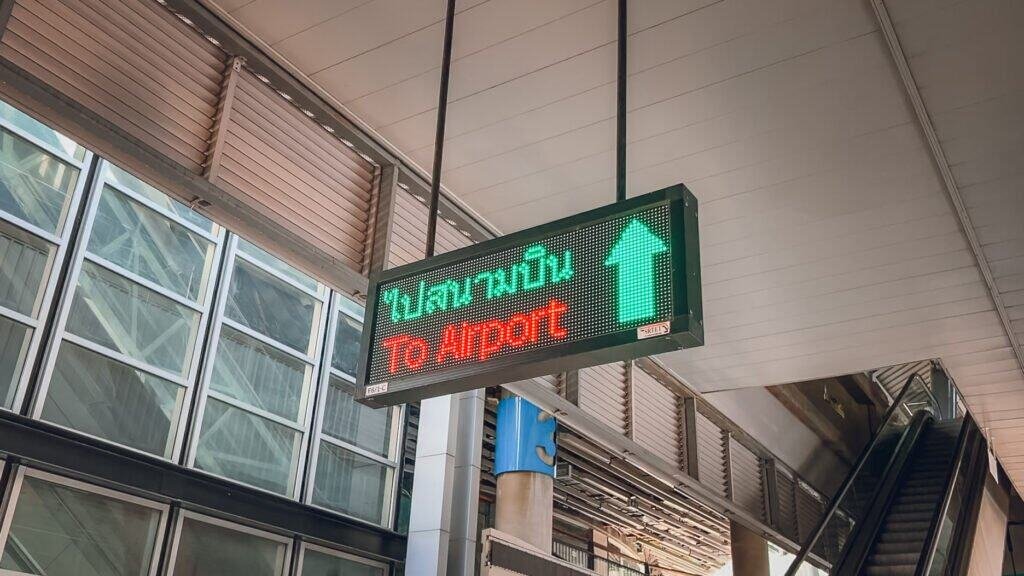
Airport rail link guide
The Airport Rail Link is an efficient way to get from Suvarnabhumi Airport into central Bangkok. It runs above the road traffic, connects directly to the BTS, and offers a reliable start to your trip.
Where the airport rail link goes
The line runs from the basement level of Suvarnabhumi Airport to Phaya Thai Station, where you can transfer to the BTS.
Key stops include:
- Suvarnabhumi Airport
- Ramkhamhaeng
- Ratchaprarop
- Makkasan (connection to MRT Phetchaburi)
- Phaya Thai (connection to BTS)
Travel time
Trips from Suvarnabhumi to Phaya Thai take 25 to 30 minutes, which is often faster than a taxi during busy hours.
How much it costs
Tickets cost 15 to 45 THB depending on how far you travel along the line.
When to use it
Use the Airport Rail Link when:
- You have a carry-on or backpack
- Your hotel is near a BTS or MRT station
- You arrive during heavy traffic
- You want a quick, predictable arrival into the city
When to skip it
A taxi or Grab is better when:
- You have large suitcases or multiple bags
- Your hotel is in Old Town, where trains do not reach
- You arrive late at night and want door-to-door travel
The Airport Rail Link only accepts Thai baht at most machines. Withdraw a small amount at the airport or use an ATM before heading to the platform.
Getting from Don Mueang Airport to the city
Don Mueang Airport is Bangkok’s second airport and is used mainly by low-cost airlines. It is north of the city and does not have a direct train into central Bangkok, so your transport options are different from Suvarnabhumi.
Grab or taxi
This is the most straightforward option. Rides to central Bangkok usually cost 300 to 500 THB, plus tolls. You see the fare before you book, there is no negotiating, and you avoid unexpected add-ons.
SRT dark red line
This commuter train stops directly at Don Mueang and goes to Krung Thep Aphiwat Central Terminal. From there, you can transfer to the MRT Blue Line and continue into the city.
It is affordable, reliable, and works well if you do not mind making one transfer.
When to choose each option
- Choose Grab or a taxi if you want a fast, comfortable door-to-door ride.
- Choose the SRT Dark Red Line if you prefer trains and do not mind a transfer.
Chao Phraya Express boat guide
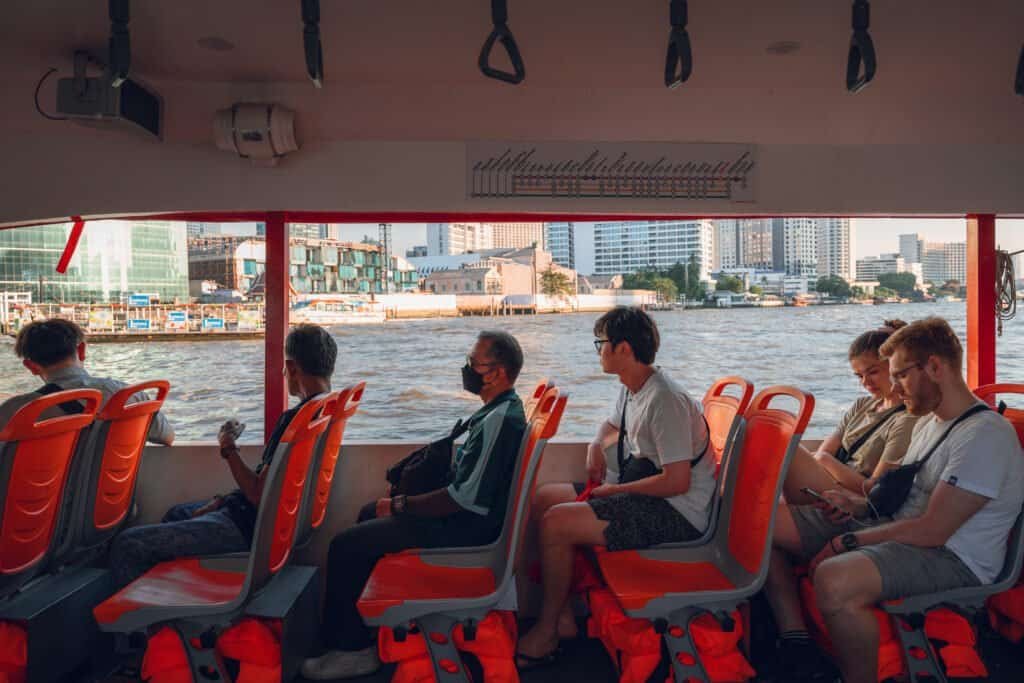
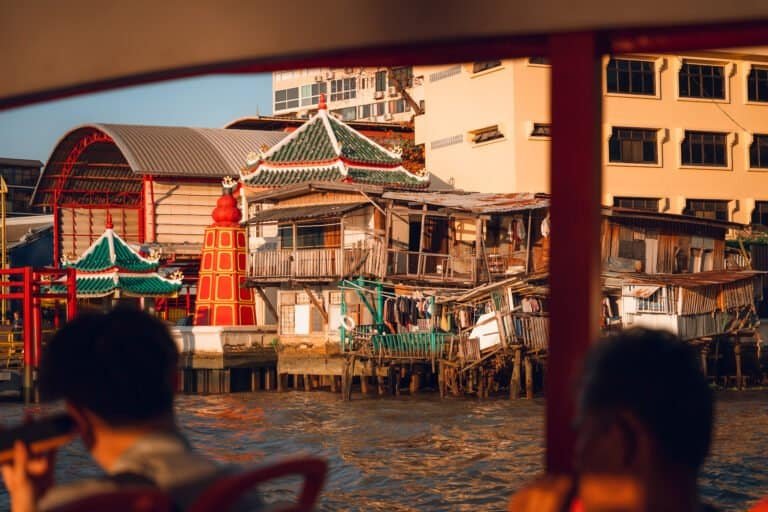
Bangkok’s river boats are a practical way to reach the Grand Palace, Wat Pho, Wat Arun, and many Old Town sights without sitting in traffic. They are used by locals every day and give you a simple, direct route to key landmarks along the river.
There are two main types of boats on the Chao Phraya. Orange flag boats are local ferries that stop at the most useful piers and are the fastest, cheapest option for getting around Old Town. Blue flag boats are tourist boats with fewer stops, more space, and higher fares, and are mainly useful if you want a slower, more relaxed ride or plan to hop on and off.
Cross-river ferries are also available at many piers. They only take a few minutes and are useful for moving between Wat Arun and the Grand Palace area.
Where to board
Most travelers start at Sathorn Pier, located a short walk from BTS Saphan Taksin. Follow the signs from the station and you will reach the pier in a few minutes.
Key piers for sightseeing
- Tha Chang: Closest pier to the Grand Palace.
- Tha Tien: Best for Wat Pho and the ferry to Wat Arun.
- Ratchawong: Handy for Chinatown.
- Iconsiam Pier: Ideal for shopping, food, and riverfront views.
River boats are especially useful when road traffic is heavy, and they make it easy to move between major Old Town sights without relying on taxis.
If you are visiting Wat Arun, Wat Pho, or the Grand Palace, the river boats are usually faster and more enjoyable than taking a taxi. You avoid road traffic and get some of the best views of the city along the way.

Taxis and Grab in Bangkok
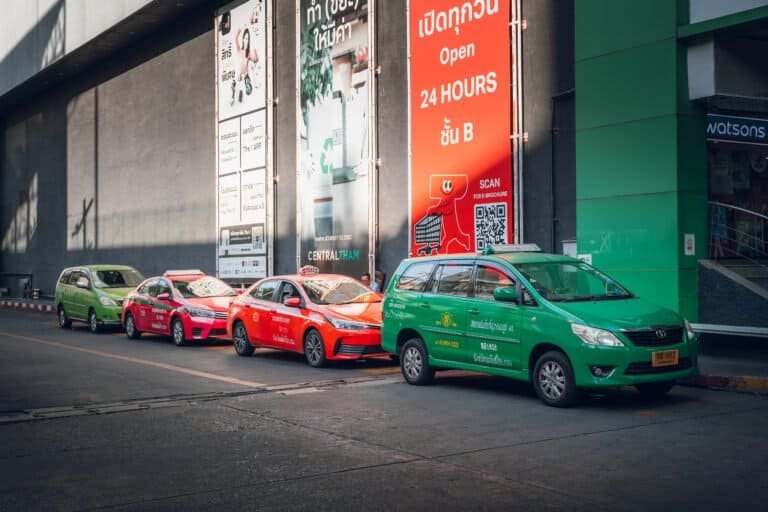
Taxis and Grab are useful when public transport is not convenient. They work well for hotel transfers, late nights, luggage, and areas far from BTS or MRT stations. Just know that regular taxis can be inconsistent, which is why many visitors prefer using Grab for predictable pricing and less negotiation.
Grab
Grab is the most reliable car service for travelers in Bangkok. You see the fare in the app before confirming, rides are logged, and there is no language barrier./
Grab works well for airport pickups, long rides, or nights out. Prices can increase during peak hours, but the overall experience is usually smoother than finding a regular taxi.
Taxis
Taxis are common across the city, but the quality varies. Some drivers refuse the meter or try to charge flat fees in tourist areas.
A normal metered ride within the city ranges from 60 to 120 THB, depending on distance. Airport trips cost more, especially when using toll roads.
When to use each one
- Grab: Best for first-time visitors, predictable pricing, airport transfers, and longer rides.
- Taxi: Useful for short city rides when traffic is light and the meter is used.
Using Grab whenever possible reduces negotiation and helps you avoid the most common taxi issues.
Tuk-tuks in Bangkok
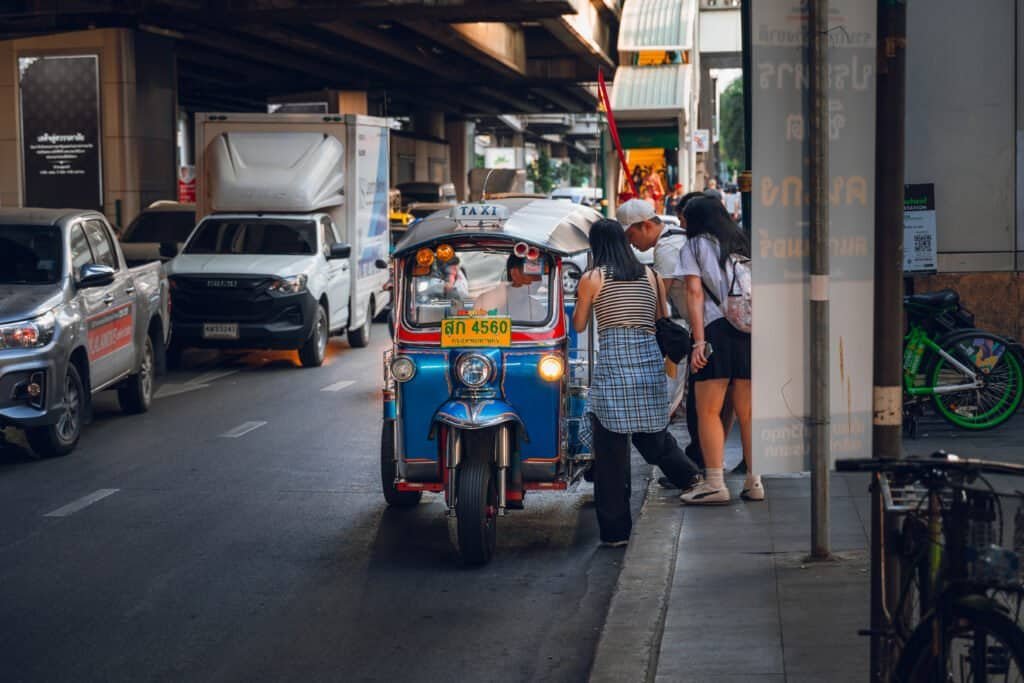
Tuk-tuks are one of Bangkok’s most iconic experiences. They are loud, fun, and memorable, but they are not the cheapest or most efficient way to get around. Use them for short rides or when you want the experience, not for crossing the entire city. Prices are more reasonable once you step away from the busiest tourist streets.
When tuk-tuks make sense
- Short rides after dinner
- Quick hops between nearby attractions
- When you want an open-air ride through the city
- When road traffic is slow and you prefer fresh air to sitting in a taxi
When to skip tuk-tuks
- Long distances
- Heavy rain or strong mid-day heat
- Airport transfers
- Any trip where BTS, MRT, or Grab is faster or more affordable
Tuk-tuks are best enjoyed as part of the experience. Use them for moments you want to remember, not for getting across Bangkok during rush hour.
Bangkok bus system: when it makes sense
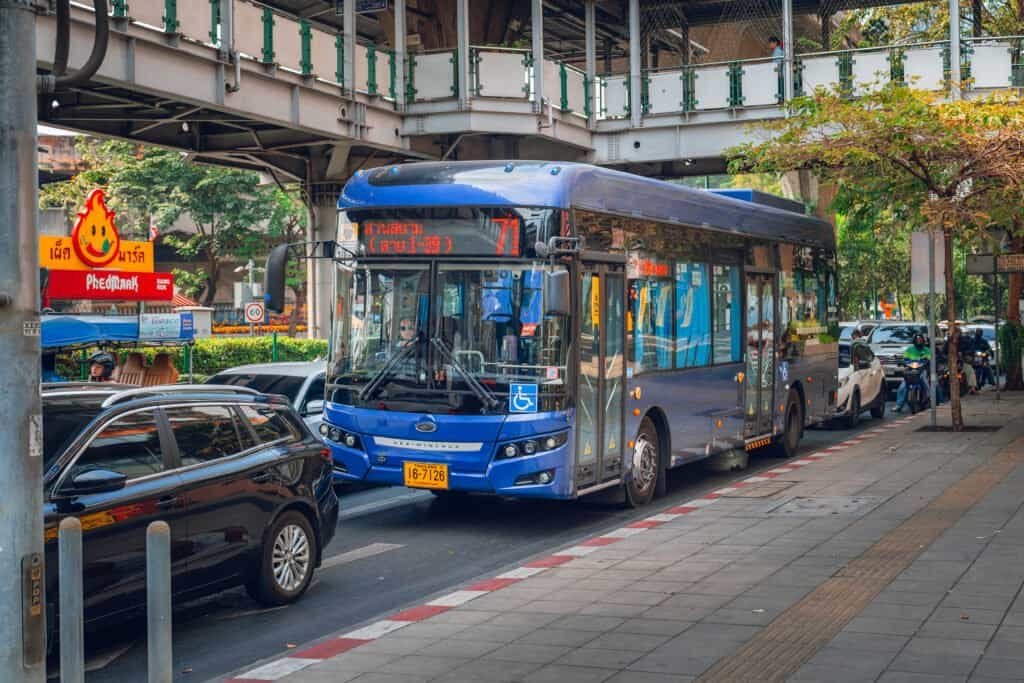
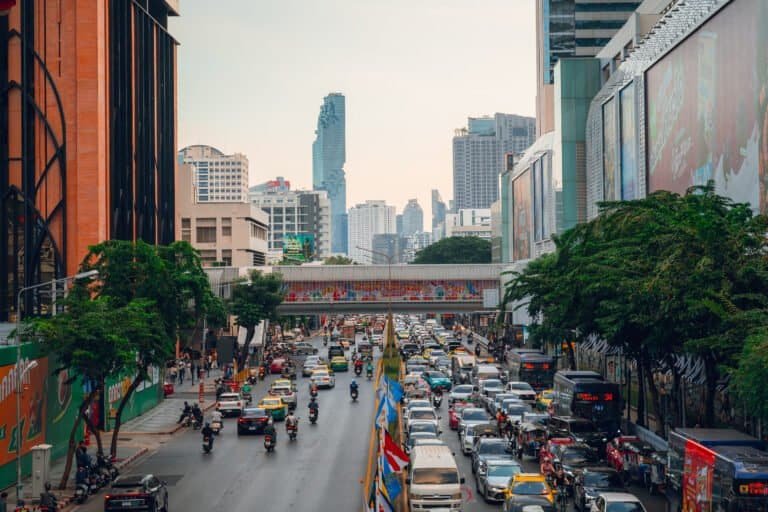
Bangkok’s buses reach almost every part of the city and are one of the cheapest ways to move around. The downside is that routes can be tricky for visitors since many signs are only in Thai. Traffic can also slow buses to a crawl. For most travelers, buses are optional. Think of them as a bonus, not your main way of getting around Bangkok.
Most first-time visitors skip buses because trains, boats, and Grab are usually faster and easier for the areas they spend time in.
Why visitors rarely use buses
- Many routes are confusing without Thai
- Traffic delays are common
- BTS, MRT, boats, and Grab are usually faster for the places most tourists visit
When buses are actually useful
- You are traveling on a tight budget
- You want a local experience and do not mind a slow pace
- A local or your hotel already told you the exact bus number to take
If you never take a Bangkok bus, you will still get around the city easily. Use the BTS, MRT, river boats, and Grab as your main systems, and save buses for days when you feel curious or want a slower adventure.
Simple route examples for first-time visitors
These examples show how most visitors think about getting around Bangkok, not exact routes to memorize. The goal is to help you choose the right transport system for common situations without over-planning.
From Suvarnabhumi Airport to a Sukhumvit hotel
If you’re traveling light and want a predictable arrival, trains are usually the easiest choice. The Airport Rail Link connects directly into the city and links with the BTS, which covers most of Sukhumvit.
If you’re tired, arriving late, or carrying larger bags, Grab or a taxi is often simpler. It’s slower in traffic, but door-to-door and low effort after a long flight.
From Sukhumvit to the Grand Palace or Wat Pho
For Old Town sights, river boats are often faster and less stressful than sitting in traffic. Many visitors take the BTS toward the river, then switch to a Chao Phraya express boat for the final stretch.
If you prefer to stay underground, the MRT also reaches Old Town areas and works well when traffic is heavy.
Crossing the city (Chinatown, markets, or north–south trips)
When a trip cuts across the city, trains are usually the most reliable option. The MRT is especially useful for places like Chinatown and large markets, and it connects easily with the BTS for longer trips.
Taxis and Grab can work when traffic is light, but trains are more predictable during busy hours.
Getting around Bangkok FAQ
Is getting around Bangkok easy?
Yes. Getting around Bangkok is simple once you learn the basics of the BTS Skytrain, MRT Subway, Airport Rail Link, river boats, and Grab. You do not need every system. Choose the ones that match your hotel location and daily plans.
How do you get around Bangkok as a tourist?
Most visitors use trains and river boats during the day, then switch to Grab at night for convenience.
How do you get around Bangkok on public transport?
Most visitors rely on the BTS Skytrain, MRT Subway, and Chao Phraya river boats to get around the city. Together, these systems cover the areas travelers spend the most time and avoid Bangkok’s worst traffic.
How do you get around Bangkok by train from the airport?
From Bangkok’s main airports, trains are a convenient option if you’re traveling light. Rail lines connect into the city and link with the BTS or MRT, making it easy to continue toward most hotel areas.
How do you get around Bangkok cheap?
The cheapest way to get around Bangkok is with the BTS, MRT, and Orange Flag river boats. These systems have low fares and avoid traffic.
Buses are even cheaper but harder for a first time visitor.
Can you get around Bangkok with English only?
Yes. BTS, MRT, Airport Rail Link, and major boats all have Thai and English signs. Most station staff can help tourists. Using Grab also removes language barriers for taxis.
Is Bangkok walkable?
Some areas are walkable, especially Sukhumvit, Siam, and parts of Old Town. Distances are larger than they look on Google Maps, and sidewalks can be uneven. Combine short walks with the BTS, MRT, or river boats for the easiest experience.
Is it safe to walk around Bangkok at night?
Most central areas are safe at night if you stay on busy and well lit streets. Keep valuables secure and switch to Grab if you feel tired, lost, or uncomfortable.
How do you get around Bangkok with kids?
Families usually stick to simple routes with fewer transfers. Trains work well during the day, river boats can be a fun short experience, and Grab is often easiest in the evenings or for longer distances.
Should you tip in Bangkok for taxis or Grab?
Tipping is not required. Locals often round up the fare or leave a small extra amount if the driver helps with luggage or waits during a short stop. It is appreciated but never expected.
Putting it all together
Before you arrive, having Google Maps and Grab set up makes getting around much easier. Carrying small bills helps for boats and ticket machines, and it’s usually best to avoid rush hour if you’re traveling with luggage. When something feels inconvenient or confusing, switching to Grab is always an easy fallback, and station staff are used to helping visitors.
Final thoughts
Getting around Bangkok feels overwhelming at first, mostly because the map looks more complicated than it is. Once you understand the main systems, everything becomes easier. You do not need to use every option or plan perfect routes. Stick to the BTS, MRT, river boats, and Grab, and adjust as you go. Once you find your rhythm, moving around the city starts to feel natural.

One Comment